Creative Activism for Kincentric Justice
Decolonize, decarcerate, demilitarize and rebuild kincentric worlds.
Course Overview
This interdisciplinary course applies artistic and poetic inquiry to international law and earth jurisprudence with (at least) two intentions:
1) to decolonize carceral legal systems—to deconstruct systems of injustice constructed by colonialism, capitalism and the bureaucratic, legislative strategies and policies that uphold and perpetuate coloniality
2) to envision, imagine, speculate and weave webs of co-existence, co-becoming, and pluriverses of mutual thriving of people, land and sea; and to reformulate an ecocentric legal system that nourishes these worlds.
The course will inaugurate our collective inquiry with the question, how can the dominant, criminal justice system be utilized to undo the carceral state that made it? And what can move the human-centric legal system towards an ecocentric law? The following seven weeks will be shaped by your questions, which might be: how can I make beauty with our plant kin to heal the wounds of colonialism? What if we sang with whales and flowers and microbes? What new worlds could we bring into being? worlds of mutual respect and relationality? How can I dance with microbes and mycellium to nourish a culture of reciprocity and an ethics of consent? Questions are the medicine that lead us into deep reflection and creation. Crafting questions hones our skills of deep listening.
Following fish philosopher Zoe Todd’s call to center Indigenous laws and sovereignty, the course takes an unapologetically anticolonial approach to design and pedagogy/andragogy. The majority of resources will draw on Indigenous knowledge and culture-keepers, BIPOC elders and activists, and Rights of Nature advocates working in solidarity with Indigenous environmental activists.
This course emerges from a generative fission between artistic process and jurisprudence to co-create protocols that disinvest from coloniality/modernity and bridge partitions between humans from “the rest of nature.” Students will learn with and participate in ecosocial justice movements through poetics, interdisciplinary arts, social sculpture, legislative action and/or narrative arts.
Who Is This Course For?
We will create a learning community for creative organizers, educators, activists, communitarians and dreamers who want to rebuild a healing justice paradigm that challenges the carceral state and opens up “the possibility of a refoundation of international law beyond states,” as Rigo and Montella wrote. This “course” is for those who long to build with others in collective creativity to concoct forms of justice that affirm life, Indigenous kincentricity and reciprocity. It is for visionary makers, performers, writers, ready to embrace imaginative action to conspire towards a radically liberatory world.
What You'll Learn
- Identify your intelligences (Gardener, multiple intelligences) and how you learn best
- Develop your own method to cultivate understanding and knowledge of different paradigms of jurisprudence (so-called “great jurisprudence”, feminist jurisprudence, earth jurisprudence, Indigenous jurisprudence)
- Articulate your inquiry… e.g. “how can I dance the tragedy of a massacre?” or “how would my banjo express the violation of earth justice?
- Move your inquiry into actionable knowledge, create an artistic intervention grounded in your inquiry and findings.
- Choose to collaborate with colleagues in the course to create a group project (e.g. a digital archive, a score or script for a theatrical performance)
What's Included
Live Sessions
Interactive classes with your instructor
Session Recordings
Lifetime access to all recordings
Community Access
Connect with fellow learners
Certificate
Proof of course completion
Course Modules
Session1: Orientation, Introductions
We co-create the learning community and begin by introducing each other to ourselves with an environmental autobiography. What land and bodies of water did we feel connected with in childhood? Where do we currently live and what is our relationship with more-than-human beings or nonhuman kin? We explore kincentric worldviews using excerpts of texts by Enrique Salmon, Sherri Mitchell, Zoe Todd, and Max Liboiron as prompts for poetic or arts-based, embodied response and exploration.
Session 2: Diagnosis: Undoing Justice and Kincentric Worldviews
This week we diagnose the systemic toxicities in which we live and breathe—the carceral state, coloniality, capitalism. We begin to imagine how to disrupt, decolonize, and liberate ourselves from those systems. We explore “strategic questioning” and craft questions that will guide our projects. How do we step back from the context we’re embroiled in to get a different view of the systems that bind us? Can we disrupt how the systems are codified and enforced? We listen to and experience artists who dance with justice and law in different ways: for example, Nadia Myre, Talking Rivers, Vivien Sansour, Rebecca Belmore, Cannupa Hanska, Marie Watt, Post Commodity and Raven Chacon, and others. The work of these artists will prompt our own arts-based exploration.
Session 3: Gesturing Towards Decolonial Futures, Vanessa Andreotti
We engage with the Gesturing Towards Decolonial Futures (GTDF) collective and the Global Citizenship Education Otherwise booklet. We practice sketching and gesture towards a project plan for experiments leading to a project. Make quick sketches, experiment slowly. Write fast, revise slowly. How do the GTDF compass questions land with you? What are your compass questions?
Session 4: Decentering Humans: Human Rights, Ecocide and Earth Jurisprudence
This week we will recite excerpts from legal documents—the Universal Declaration of Human Rights, the UN Convention on the Prevention and Punishment of Genocide, and ecocide laws. Each of us will choose a method of responding to, integrating, disrupting and/or transforming the legal documents through arts-based methodologies. We will also review Indigenous law documents. We encourage each other to dive in and make an artwork, poem, performance and test it in on the streets, in the field or neighboring forest.
Session 5: Center for Artistic Activism (C4AADesign ), Halpring’s RSVP Cycle, Method & Evaluation
We share our project sketches, plans, ideation, engage the iterative process of emergent artmaking. What are the methods of evaluation most appropriate for your project? We review scaffoldings for artistic process developed by the Center for Artistic Activism, AEffect project planning, Lawrence Halprin’s RSVP Cycle, and revisit GTDF experiments.
Session 6: Kincentric Practice
This week we spiral down into a kincentric worldview, bringing our attention to a nonhuman being. We recite ecocide laws and Rights of Nature laws, this time practicing attunement to a nonhuman being. It could be water, air, wind, river, mountain, four-legged and furred, fungi or winged being. Consider each of our projects from the perspective of these beings.
Session 7: Evaluate, Iterate
By this week, each of us has created some act or work of creative activism. A poem, a gesture, a song, a dance. You’ve witnessed the emergence of this butterfly and releasedit into the world. What happened? How did it work? What would you change next time?
Session 8: Celebrate and Co-create
For our final session, we share our projects and celebrate our journeys. We sense whether future collaborations might emerge, other worlds might comingle and co-become.
Real-World Project
We will be drafting, sketching, and designing throughout the semester. Students will determine whether we work on a single project, such as the production of a theatrical performance, or co-create a project that has several elements such as a poetry manuscript, an installation piece and a website that allows the project to expand.
About the Instructor
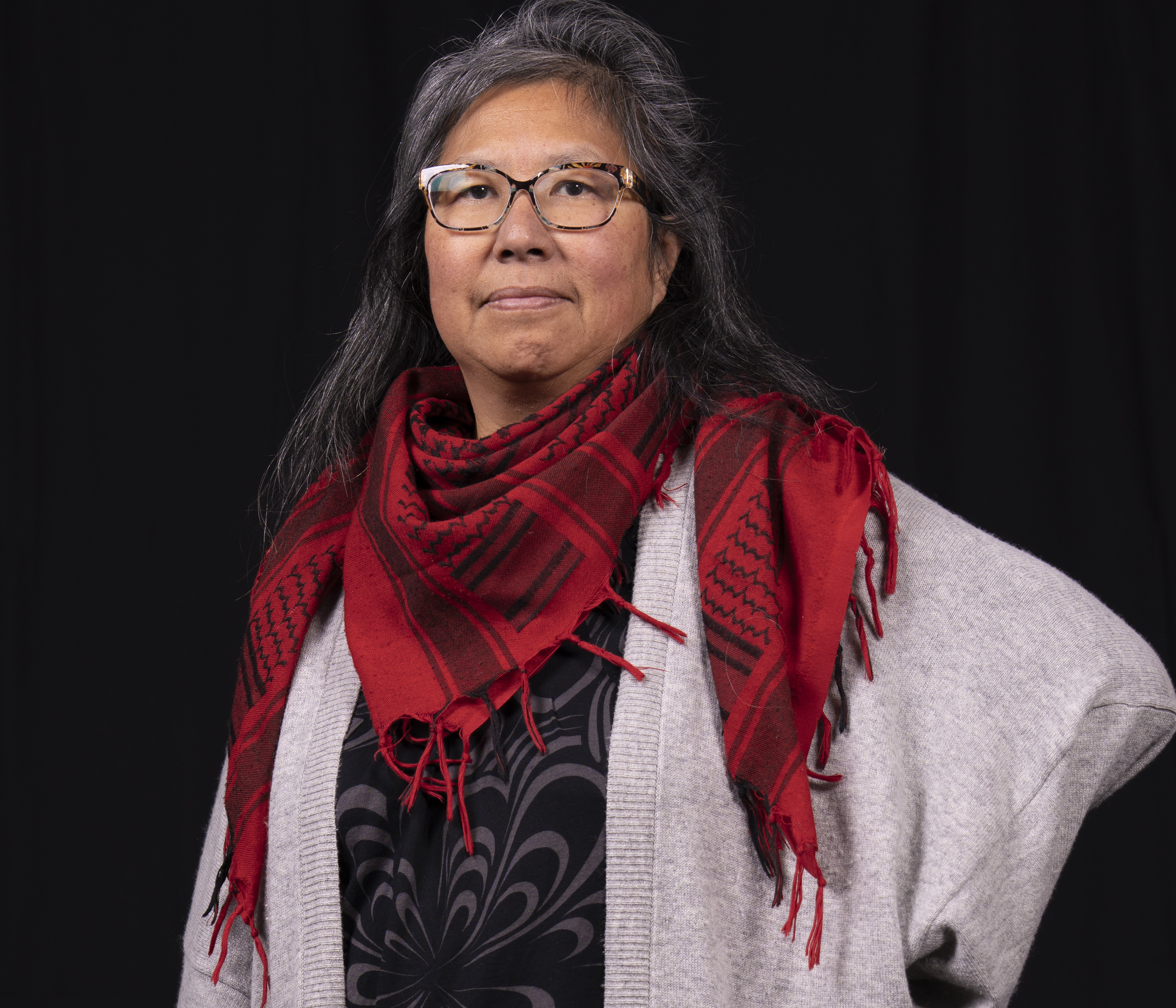
From the river to the sea, from mountain rainbow to darkest bed of soil, we shall all be free
A daughter of Taiwanese farmers and brickmakers, JuPong Lin invokes the medicine of art and poetics in the struggle to rekindle kincentric worlds. She resides in Nipmuc homelands in Western Massachusetts, where she co-created The PeaceBirds Project, an arts-centered, movement-building initiative that holds space for collective grief as we witness atrocities committed near and afar, in Northeast USA and in the Levant. Her first play, Phoenix in the HolyLand, links local activism for a ceasefire in Gaza with the growing international movement against genocide. Writing this play reignited a fervent desire to decolonize, decarcerate and demilitarize the state apparatus—the modern nation-state. As a member of the Land Lovers collective, she is learning to embrace darkness and revel in migratory unbelonging.
$800
Join the waitlist
Sign up to be notified when registration opens.
Live Online
20 students max
8 sessions
90 min each
You Might Also Like
Relational Leadership as Design

Collective Liberation & AI: A Decolonial Practice
Beyond Sustainability: Connecting Deeper to the Environmental Conversation
